When the Dollar Wobbles: Why Exchange Rates Deserve a Bigger Seat in Your Thai Property Budget
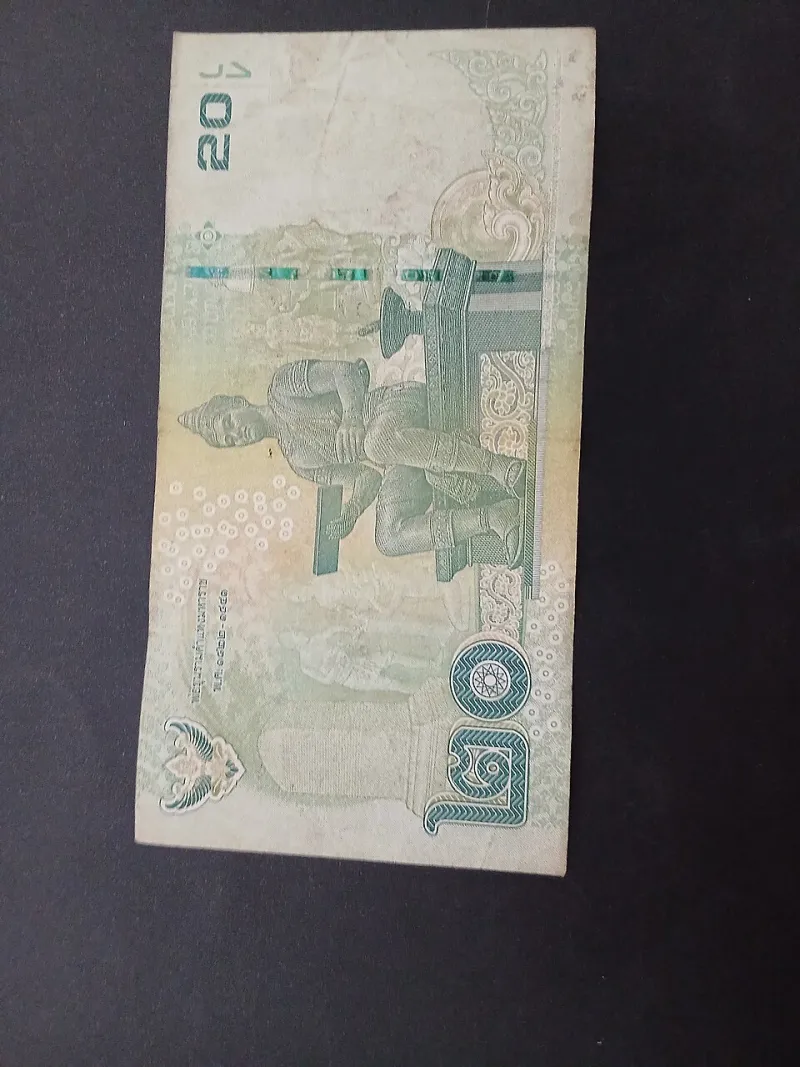
Photo: Suntuniustin, Public domain, via Wikimedia Commons
American homebuyers are trained to obsess over one number: the interest rate. We compare 6.5% against 6.25%, argue over points, and refinance for an eighth of a percent. But when the property sits in Thailand and your income sits in dollars, a far larger variable enters the equation — and most buyers never model it.
The baht has moved roughly 20% against the dollar within single multi-year stretches over the past two decades. No Thai mortgage rate has ever done that.
What Currency Movement Actually Does to Your Cost
Suppose you're saving toward a 6 million baht condominium in Chiang Mai. At 36 THB/USD, that's about $167,000. If the baht strengthens to 30 — a level it touched as recently as 2022–2023 — the same condo costs you $200,000. The seller changed nothing. The market changed nothing. Your bill simply grew by $33,000 because of where the exchange rate sat on the day you transferred funds.
The effect works in reverse, too. Buyers who moved money in 2020, when the baht traded near 32, watched it weaken past 36 by late 2021. Someone transferring $100,000 in December 2021 received roughly 400,000 more baht than the same transfer would have fetched a year earlier. Timing, not negotiation, produced that discount.
For buyers already carrying a Thai mortgage while earning in dollars, the math runs monthly. A 40,000 baht payment is $1,111 at 36, but $1,250 at 32. That's a $1,670-per-year swing on a single property — before you touch insurance, maintenance, or management fees.
Lump Sum or Installments: The Transfer Question
One of the most common questions we receive at Kredtrakarn Home is whether to convert funds all at once or in tranches. There's no universally correct answer, but there is a disciplined framework.
Choose a lump sum when: the purchase is imminent, the amount is fixed, and you can tolerate the risk of a short-term adverse move. Delaying a closing to gamble on the rate is speculation, not planning. Also note that Thai banks and the Land Department care about clean documentation — a single incoming foreign-currency transfer with a proper Foreign Exchange Transaction Form is far simpler to paper-trail than twenty scattered ones.
Choose installments when: you're building toward a future purchase and have no fixed deadline. Dollar-cost averaging into baht over 12–24 months smooths out the spikes. You will not catch the bottom — nobody does — but you also won't transfer your entire down payment the week before a political shock or a Federal Reserve surprise.
A hybrid approach works for many American buyers: convert enough now to cover the deposit and closing costs, then average the remainder toward the balance.
Hedging Options for the Individual Buyer
Institutional investors hedge currency exposure all day; individuals have fewer tools, but a few are workable:
- Forward contracts. Some US brokers and specialized currency firms let retail clients lock today's rate for a transfer months out. Expect minimums and fees, but for a large scheduled closing, it converts uncertainty into a known number.
- Multi-currency accounts. Holding baht at an international-friendly bank lets you buy when the rate is favorable rather than when the bill is due.
- A Thai bank account with a baht buffer. Keeping six to twelve months of mortgage payments in baht in Thailand decouples your payment schedule from month-to-month rate noise.
- Matching assets to liabilities. If your mortgage is in baht, some baht-denominated savings — even low-interest Thai fixed deposits — act as a natural offset.
Stress-Testing Your Budget
Before signing anything, run your numbers through three exchange-rate scenarios: the current rate, a 10% stronger baht, and a 15% weaker baht. If your monthly obligation in dollars becomes unmanageable under the strong-baht case, the loan is too large — regardless of how attractive the interest rate looks.
A property you can afford across all three scenarios is one you can hold through a full currency cycle. In Thai real estate, that cycle — not the rate sheet — is what determines whether your purchase was a sound decision.